UMWELT Amstel 2026
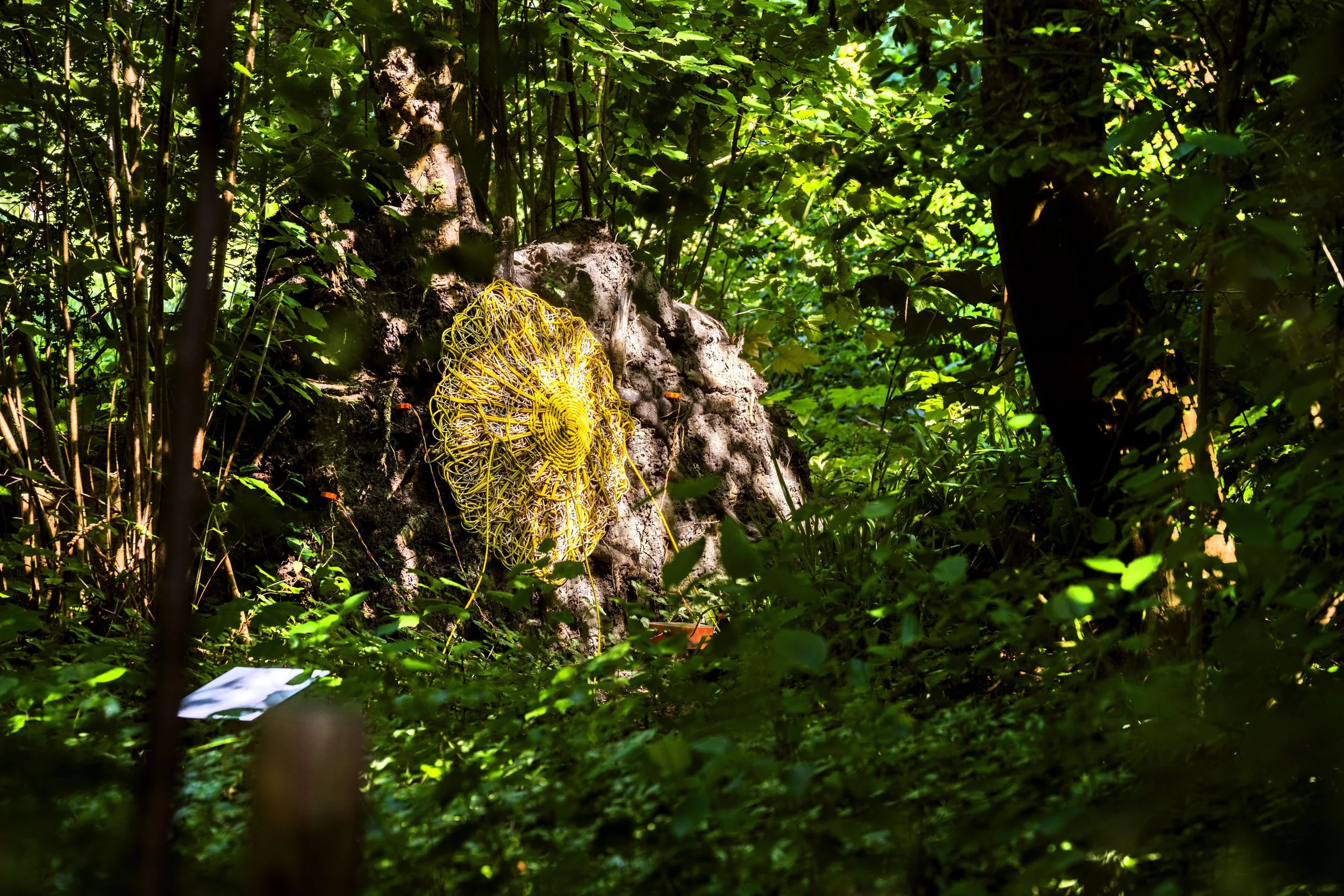
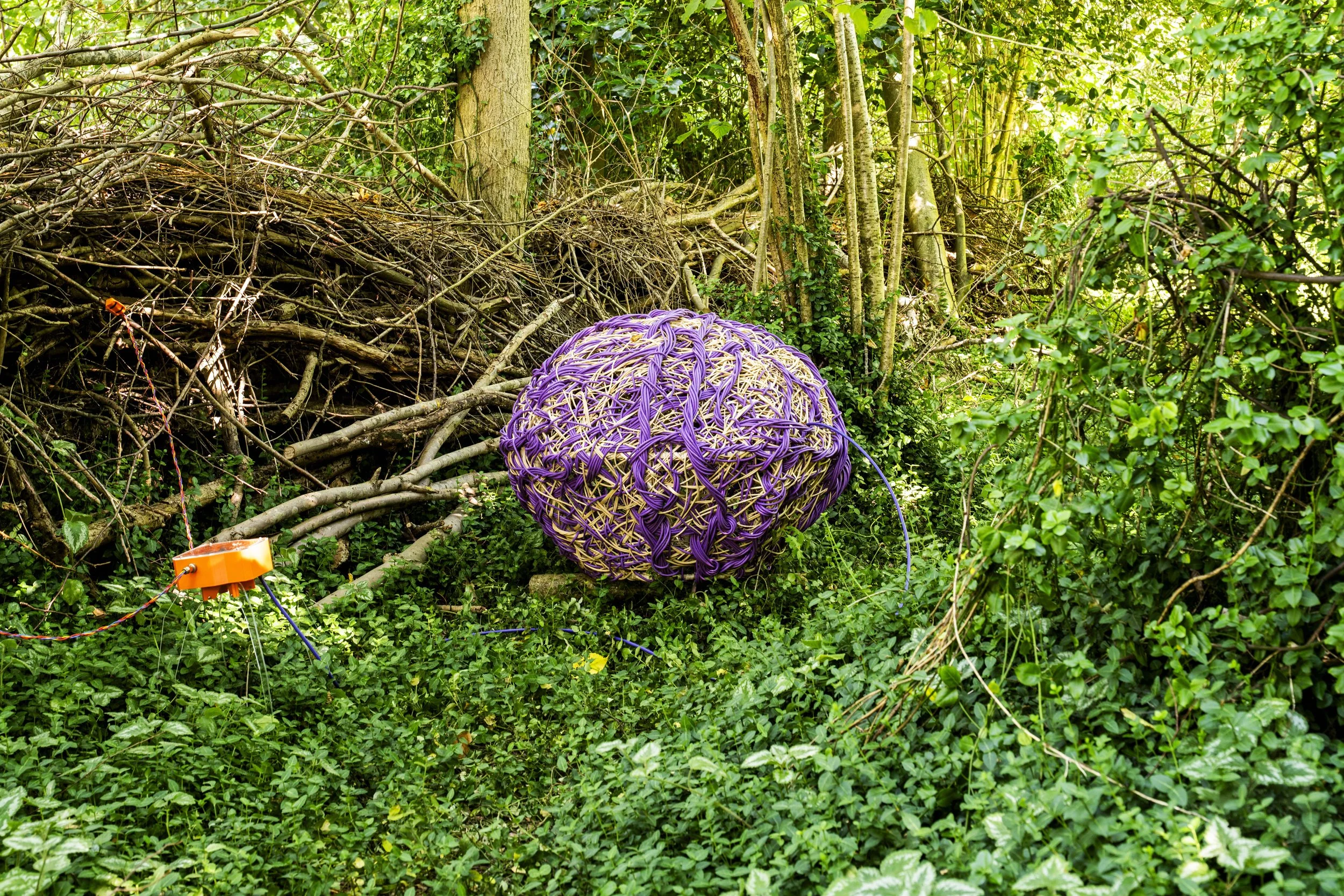
(image of portal sculpture UMWELT Root, photo by Roel Backaert)
Site-specific installation with sculptures woven with rotan, data cables, custom-made electronics, ant colonies in plaster and glass sculptures and a digital live-simulated environment
The installation UMWELT Amstel explores the possible entanglements of various entities within the Amstelpark. Central to this is the connections between the living world present in the park and the technological infrastructure that we as humans have built in the urban environment: from insect hedges and tree roots to underground data cables and servers. The work playfully seeks a way to make visible new, unexpected connections and the intertwining of these different systems with our human existence.
For the project, artist Floris Schönfeld has developed four site-specific sculptures titled Portals, which are placed around the Glass House. These sculptures are connected to the existing work PUK* Processor and the new work SIM Amstel, which are positioned inside the pavilion. All works are connected to one another via a mesh of data cables installed above ground in the park.
Credits
weaving design & execution Esmé Hofman
sculpture design & technical execution Matteo Casarin
custom sensor development & 3D printing Carlos Dalla Fiore
digital simulation developed by Misa Skalskis
metal work Rijk Broertjes
ant colonies & support Ant’s Kingdom
this project was made possible with generous sponsoring by Redlink and Ledlease
and financial support from Kunst & Cultuur Stadsdeel Amsterdam Zuid, Amsterdams Fonds voor de Kunst and the Mondriaan Fonds.
with special thanks to Jeroen de Graaf, Arnold Fabrie and Jan Peter Oudenampsen
Detail UMWELT Amstel Portal sculptures
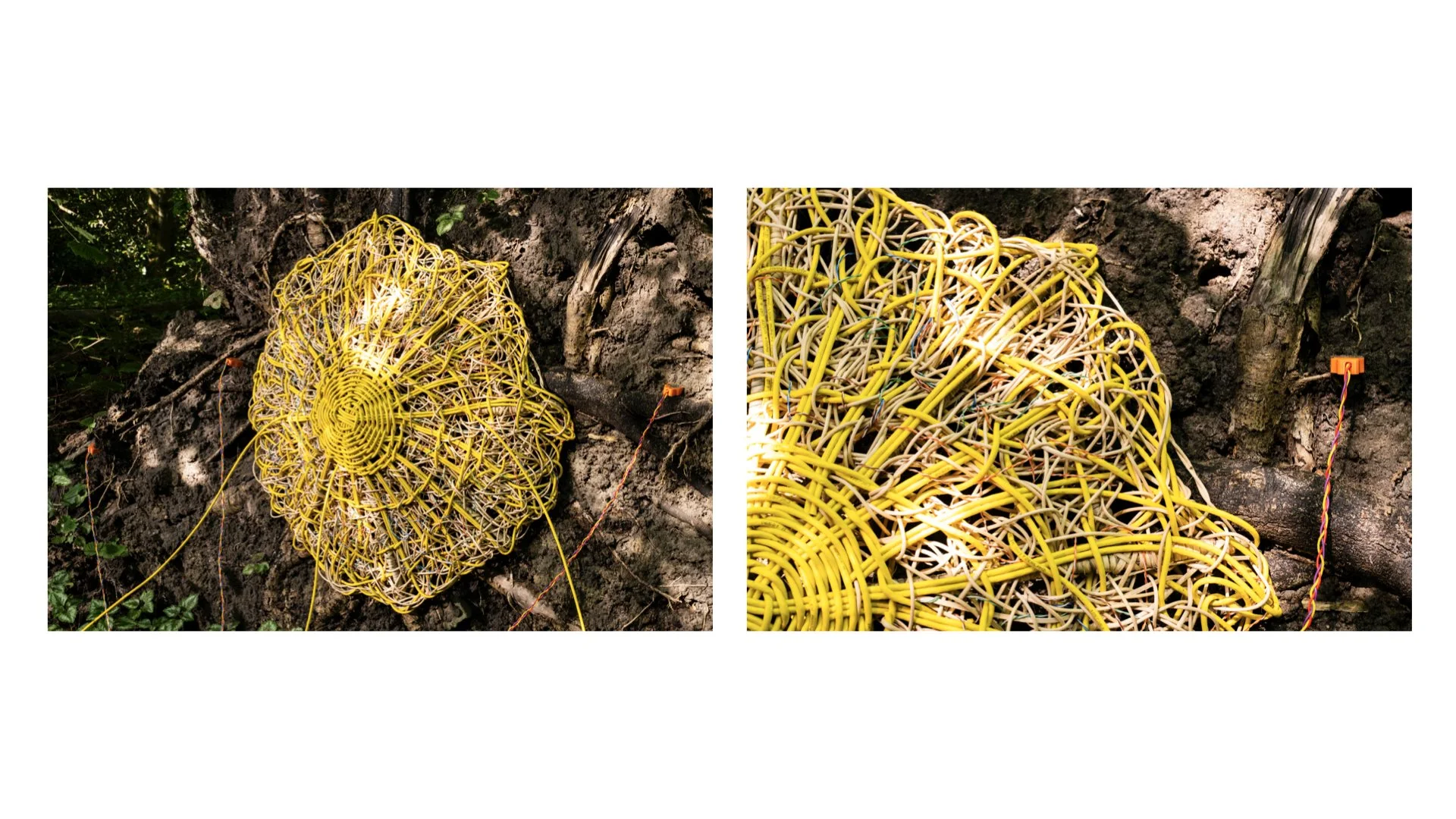
Details of portal sculpture UMWELT Root (photo’s by Roel Backaert)
Portal Sculptures
The starting point for these site-specific sculptures are natural structures in the park’s landscape, such as tree stumps, insect hedges, and clumps of fallen trees. Together with designer Matteo Casarin, artist Floris Schönfeld developed these forms into hybrid sculptures in which natural materials such as willow and rotan are interwoven with data cables and sensors. These works, developed through intensive collaboration with designer and weaving artist Esmé Hofman, combine traditional reed and willow weaving with cable weaving techniques used in contemporary data centers.
A series of custom-made electronic sensors developed by Carlos Dalla-Fiore are embedded in the sculptures measuring a number of environmental factors. These sculptures and the sensors they contain are connected to one another via a network or mesh of data cables running above ground through the park, forming a visual and thematic line.
UMWELT Amstel Portal sculptures
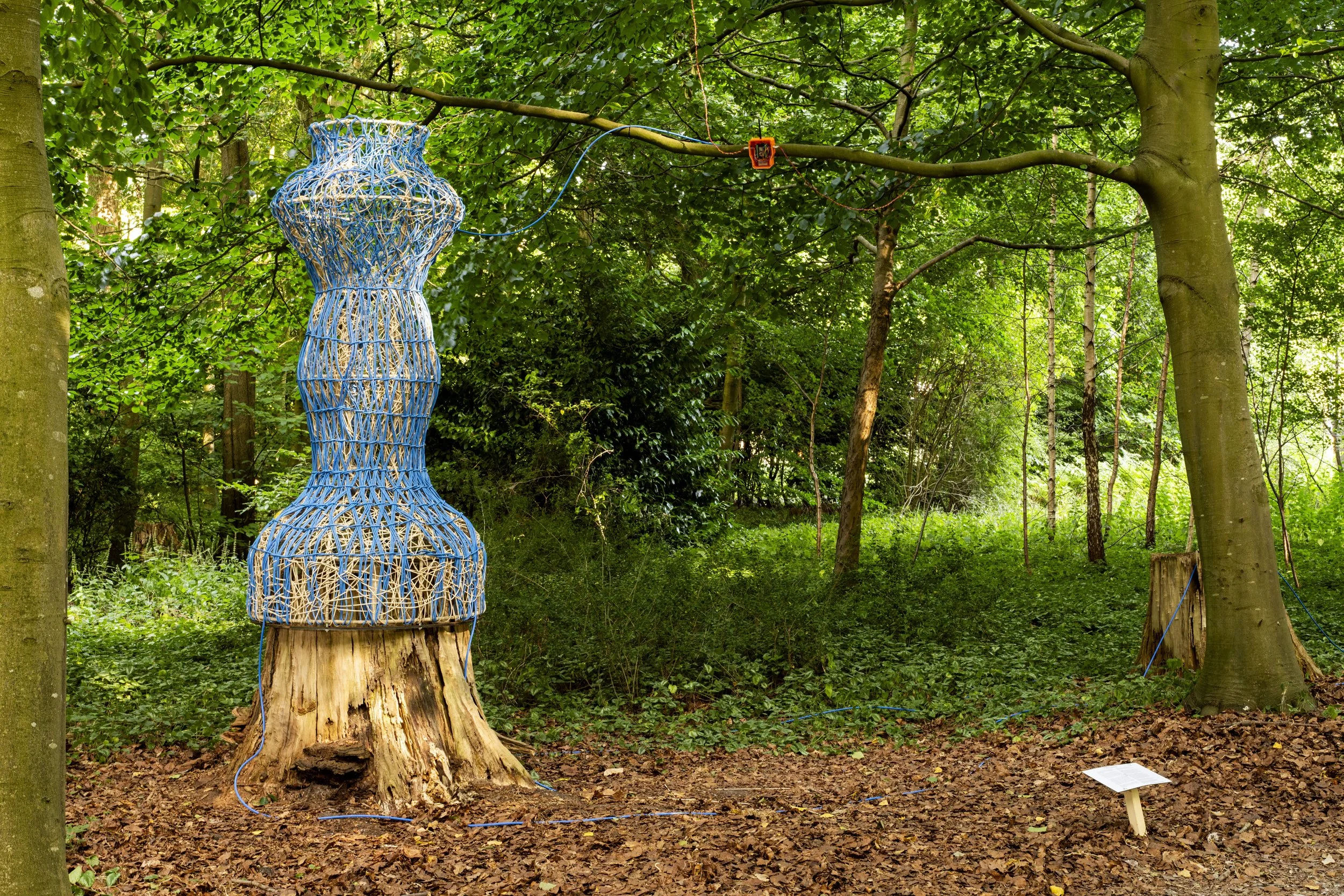
Overview of portal sculpture UMWELT Tree (photo by Roel Backaert)
Portal Sculptures
The starting point for these site-specific sculptures are natural structures in the park’s landscape, such as tree stumps, insect hedges, and clumps of fallen trees. Together with designer Matteo Casarin, artist Floris Schönfeld developed these forms into hybrid sculptures in which natural materials such as willow and rotan are interwoven with data cables and sensors. These works, developed through intensive collaboration with designer and weaving artist Esmé Hofman, combine traditional reed and willow weaving with cable weaving techniques used in contemporary data centers.
A series of custom-made electronic sensors developed by Carlos Dalla-Fiore are embedded in the sculptures measuring a number of environmental factors. These sculptures and the sensors they contain are connected to one another via a network or mesh of data cables running above ground through the park, forming a visual and thematic line.
Detail UMWELT Amstel Portal sculptures
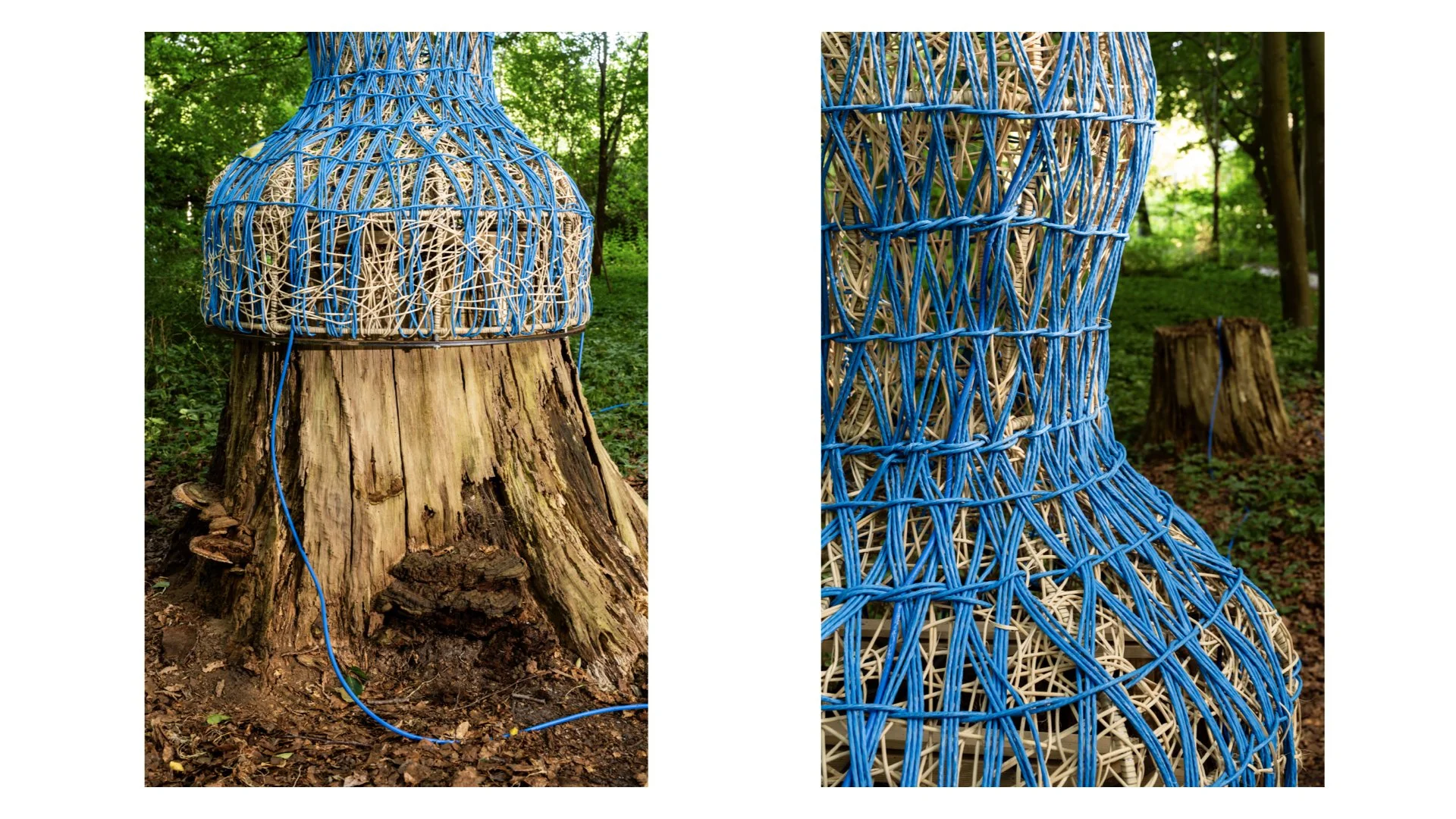
Details of portal sculpture UMWELT Tree (photo’s by Roel Backaert)
Portal Sculptures
The starting point for these site-specific sculptures are natural structures in the park’s landscape, such as tree stumps, insect hedges, and clumps of fallen trees. Together with designer Matteo Casarin, artist Floris Schönfeld developed these forms into hybrid sculptures in which natural materials such as willow and rotan are interwoven with data cables and sensors. These works, developed through intensive collaboration with designer and weaving artist Esmé Hofman, combine traditional reed and willow weaving with cable weaving techniques used in contemporary data centers.
A series of custom-made electronic sensors developed by Carlos Dalla-Fiore are embedded in the sculptures measuring a number of environmental factors. These sculptures and the sensors they contain are connected to one another via a network or mesh of data cables running above ground through the park, forming a visual and thematic line.
UMWELT Amstel Portal sculptures
Overview of portal sculpture UMWELT Hedge (photo by Roel Backaert)
Portal Sculptures
The starting point for these site-specific sculptures are natural structures in the park’s landscape, such as tree stumps, insect hedges, and clumps of fallen trees. Together with designer Matteo Casarin, artist Floris Schönfeld developed these forms into hybrid sculptures in which natural materials such as willow and rotan are interwoven with data cables and sensors. These works, developed through intensive collaboration with designer and weaving artist Esmé Hofman, combine traditional reed and willow weaving with cable weaving techniques used in contemporary data centers.
A series of custom-made electronic sensors developed by Carlos Dalla-Fiore are embedded in the sculptures measuring a number of environmental factors. These sculptures and the sensors they contain are connected to one another via a network or mesh of data cables running above ground through the park, forming a visual and thematic line.
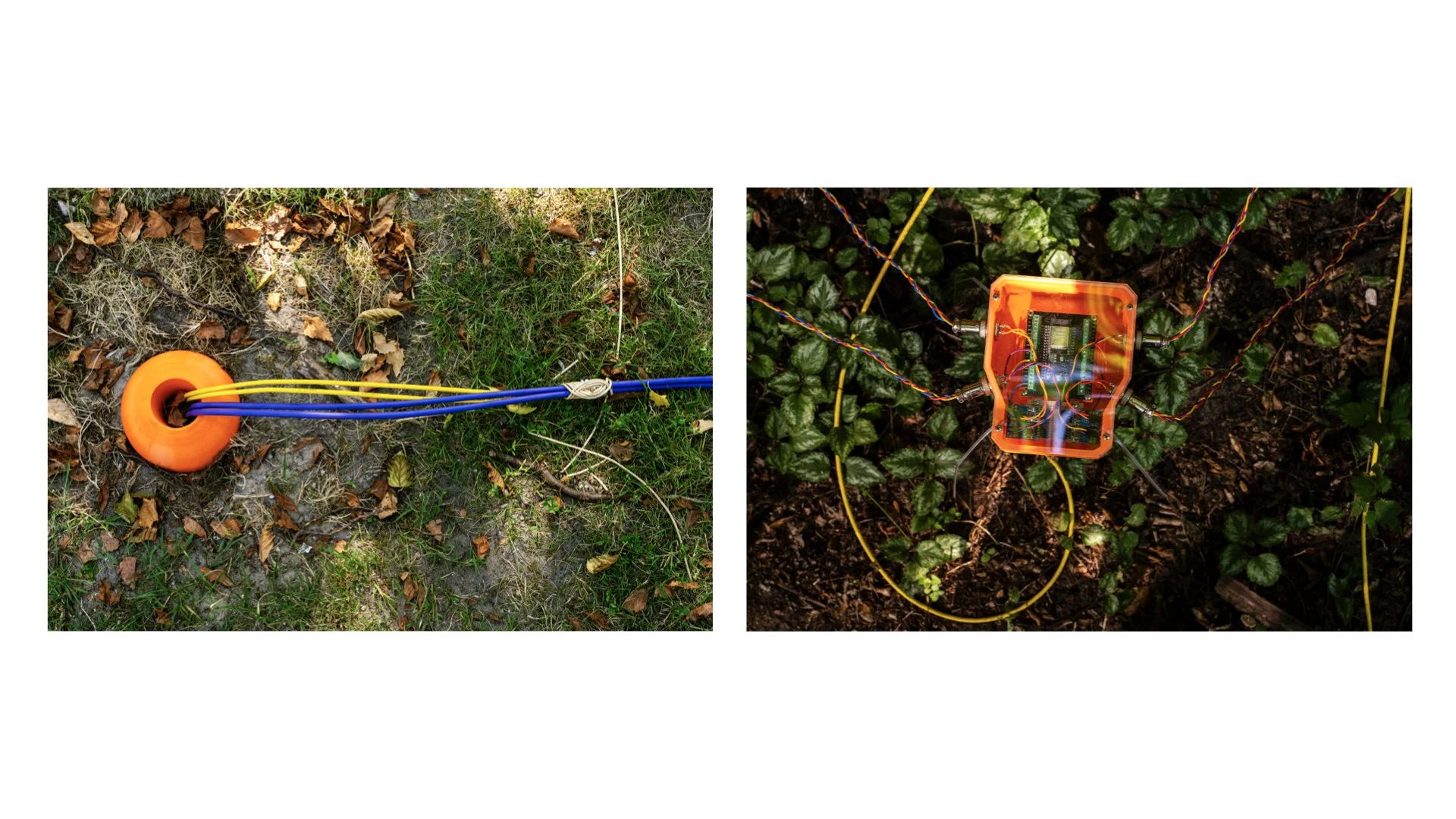
Detail UMWELT Amstel Portal sculptures
Details of portal sculpture UMWELT Hedge (photo by Roel Backaert)
Portal Sculptures
The starting point for these site-specific sculptures are natural structures in the park’s landscape, such as tree stumps, insect hedges, and clumps of fallen trees. Together with designer Matteo Casarin, artist Floris Schönfeld developed these forms into hybrid sculptures in which natural materials such as willow and rotan are interwoven with data cables and sensors. These works, developed through intensive collaboration with designer and weaving artist Esmé Hofman, combine traditional reed and willow weaving with cable weaving techniques used in contemporary data centers.
A series of custom-made electronic sensors developed by Carlos Dalla-Fiore are embedded in the sculptures measuring a number of environmental factors. These sculptures and the sensors they contain are connected to one another via a network or mesh of data cables running above ground through the park, forming a visual and thematic line.
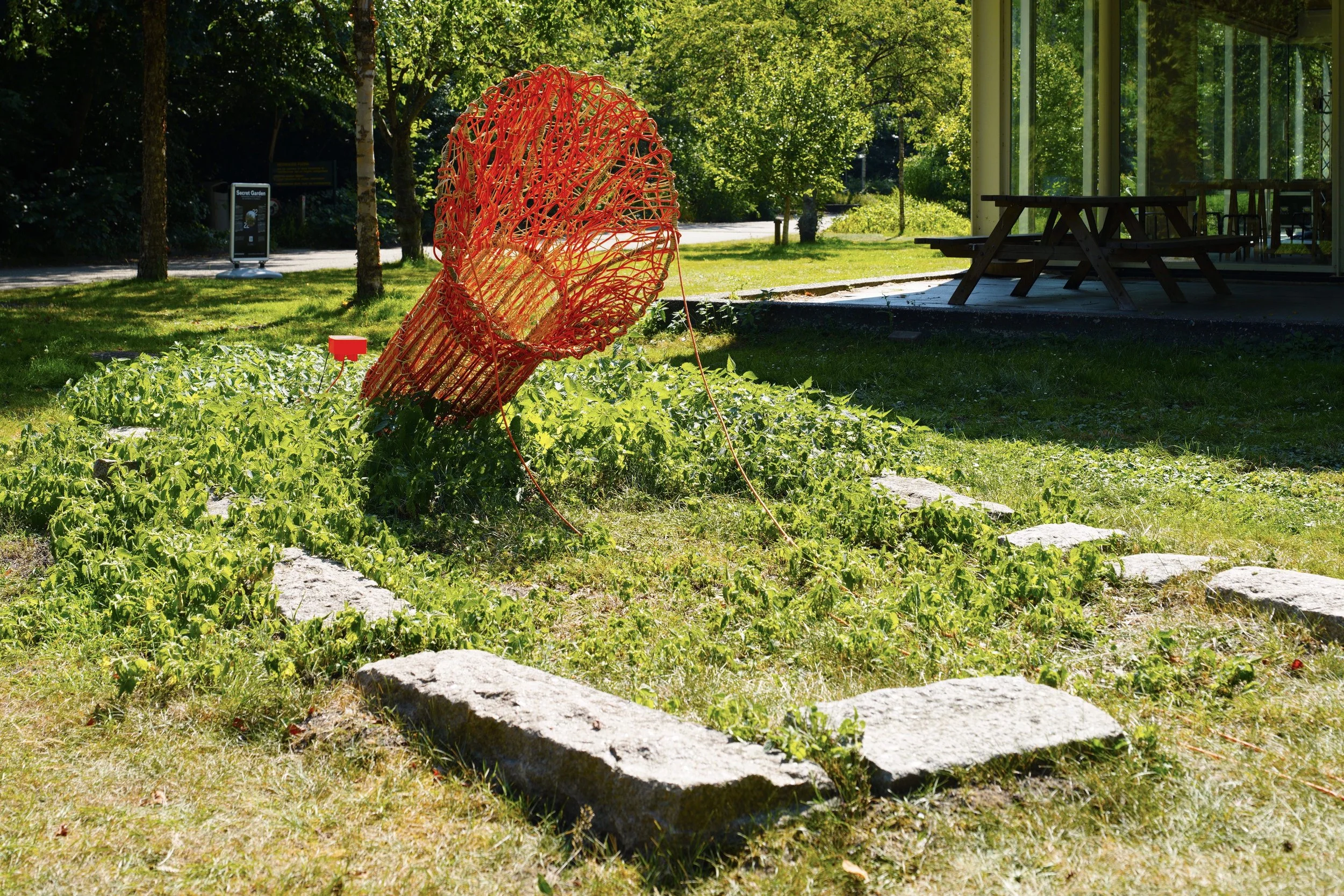
UMWELT Amstel Portal sculptures
Overview of portal sculpture UMWELT Reciever (photo by Roel Backaert)
Portal Sculptures
The starting point for these site-specific sculptures are natural structures in the park’s landscape, such as tree stumps, insect hedges, and clumps of fallen trees. Together with designer Matteo Casarin, artist Floris Schönfeld developed these forms into hybrid sculptures in which natural materials such as willow and rotan are interwoven with data cables and sensors. These works, developed through intensive collaboration with designer and weaving artist Esmé Hofman, combine traditional reed and willow weaving with cable weaving techniques used in contemporary data centers.
A series of custom-made electronic sensors developed by Carlos Dalla-Fiore are embedded in the sculptures measuring a number of environmental factors. These sculptures and the sensors they contain are connected to one another via a network or mesh of data cables running above ground through the park, forming a visual and thematic line.
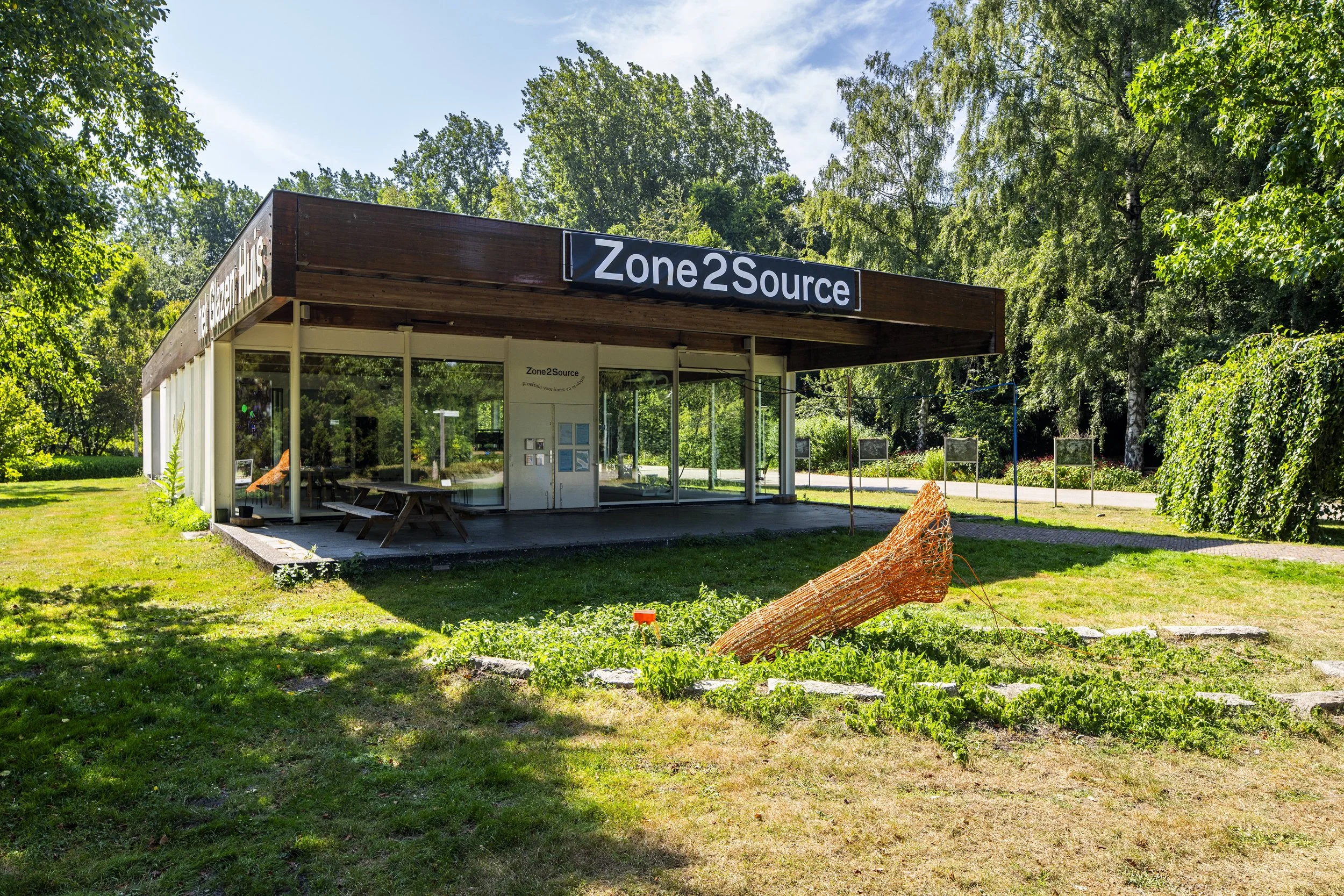
UMWELT Amstel Portal sculptures
Overview of portal sculpture UMWELT Hedge with exhibition space zone2source in the background. (photo by Roel Backaert)
Portal Sculptures
The starting point for these site-specific sculptures are natural structures in the park’s landscape, such as tree stumps, insect hedges, and clumps of fallen trees. Together with designer Matteo Casarin, artist Floris Schönfeld developed these forms into hybrid sculptures in which natural materials such as willow and rotan are interwoven with data cables and sensors. These works, developed through intensive collaboration with designer and weaving artist Esmé Hofman, combine traditional reed and willow weaving with cable weaving techniques used in contemporary data centers.
A series of custom-made electronic sensors developed by Carlos Dalla-Fiore are embedded in the sculptures measuring a number of environmental factors. These sculptures and the sensors they contain are connected to one another via a network or mesh of data cables running above ground through the park, forming a visual and thematic line.
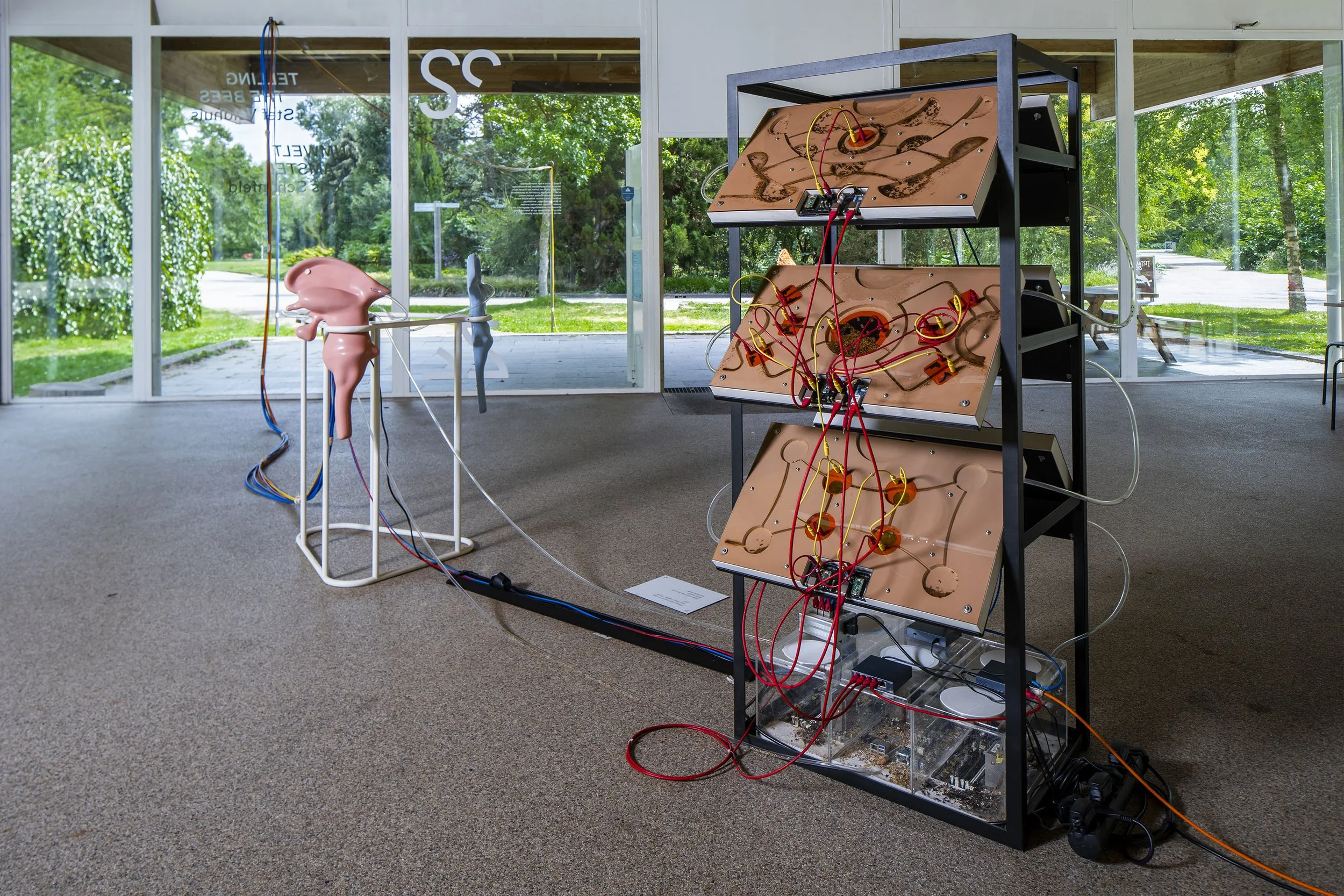
UMWELT Amstel PUK* Processor
Overview of PUK* Processor inside exhibition space zone2source with cables running outside connecting the work to the Portal sculptures. (photo by Roel Backaert)
PUK* Processor (2020) is a specially developed computer server that houses two large ant colonies. The work contains a series of working computational components embedded in plaster modules. Two ant colonies of the species Messor Barbarus live throughout this computational infrastructure. The work brings together two information systems: the binary computational signals of the machines and the pheromone-driven communication of the ant colonies. The work was developed in close collaboration with Matteo Casarin and Ant’s Kingdom.
Within UMWELT Amstel installation PUK* Processor forms a kind of hub into which the sensor data collected outside in the Portal sculptures is funnelled. The two logics of the sensor data and ant colonies collide within the work, creating both the possibility of a malfunction in both systems and, at the same time, a potential symbiosis.
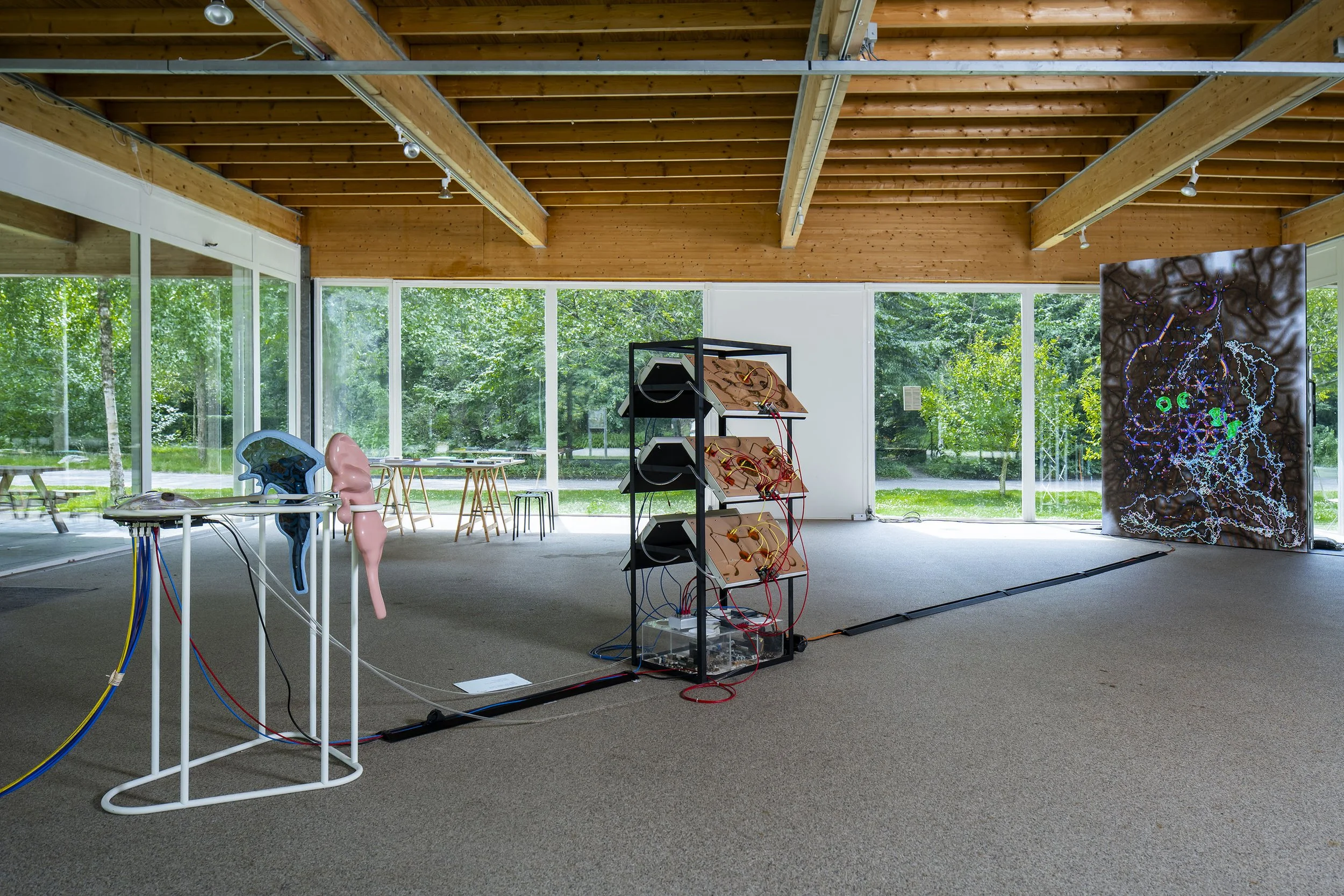
UMWELT Amstel PUK* Processor
Overview of PUK* Processor inside exhibition space zone2source with LED screen showing the live-generated video work SIM Amstel on the back right. (photo by Roel Backaert)
PUK* Processor (2020) is a specially developed computer server that houses two large ant colonies. The work contains a series of working computational components embedded in plaster modules. Two ant colonies of the species Messor Barbarus live throughout this computational infrastructure. The work brings together two information systems: the binary computational signals of the machines and the pheromone-driven communication of the ant colonies. The work was developed in close collaboration with Matteo Casarin and Ant’s Kingdom.
Within UMWELT Amstel installation PUK* Processor forms a kind of hub into which the sensor data collected outside in the Portal sculptures is funnelled. The two logics of the sensor data and ant colonies collide within the work, creating both the possibility of a malfunction in both systems and, at the same time, a potential symbiosis.
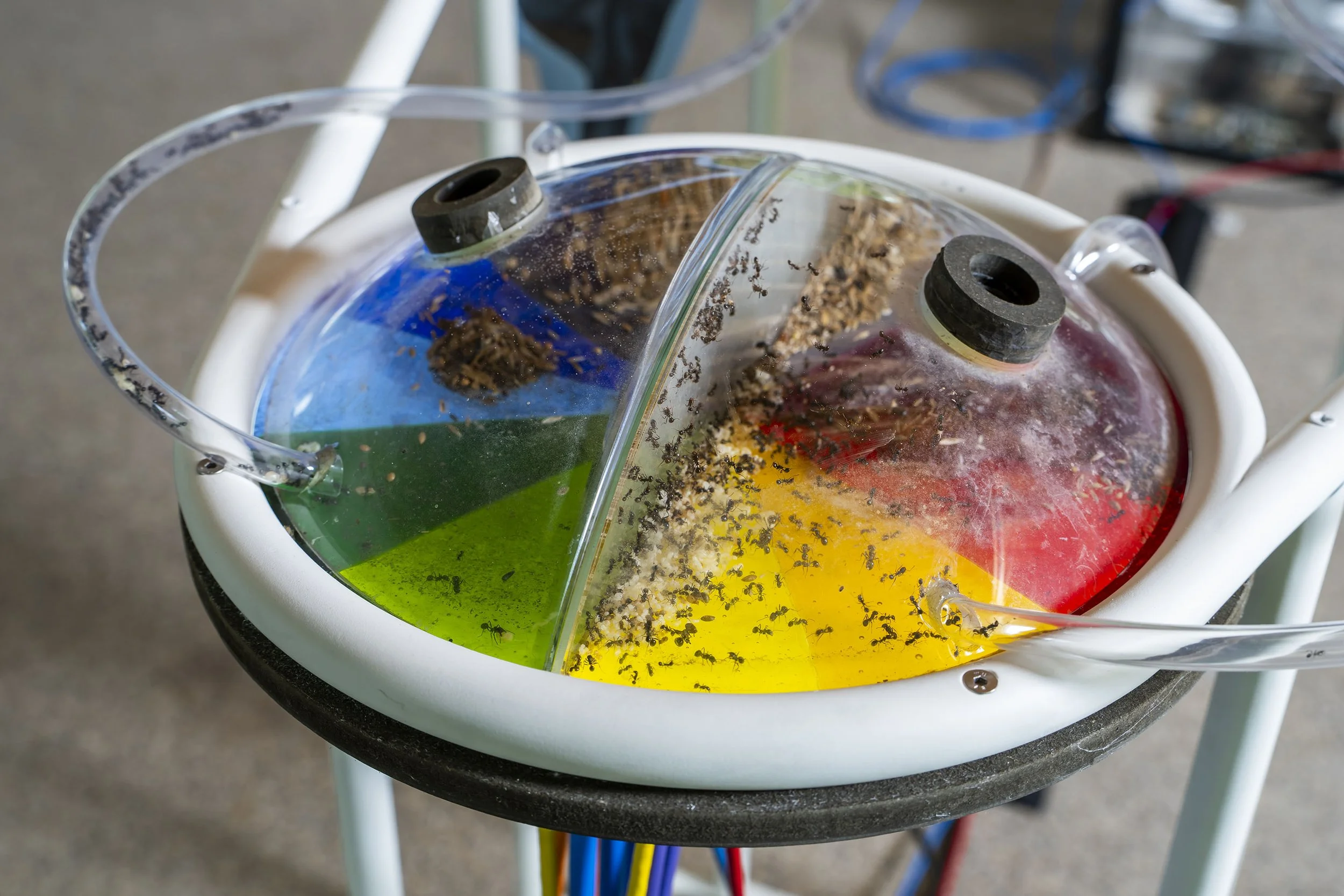
Detail UMWELT Amstel PUK* Processor
Detail of PUK* Processor inside exhibition space zone2source showing ants from two different Messor Barbarus colonies. (photo by Roel Backaert)
PUK* Processor (2020) is a specially developed computer server that houses two large ant colonies. The work contains a series of working computational components embedded in plaster modules. Two ant colonies of the species Messor Barbarus live throughout this computational infrastructure. The work brings together two information systems: the binary computational signals of the machines and the pheromone-driven communication of the ant colonies. The work was developed in close collaboration with Matteo Casarin and Ant’s Kingdom.
Within UMWELT Amstel installation PUK* Processor forms a kind of hub into which the sensor data collected outside in the Portal sculptures is funnelled. The two logics of the sensor data and ant colonies collide within the work, creating both the possibility of a malfunction in both systems and, at the same time, a potential symbiosis.
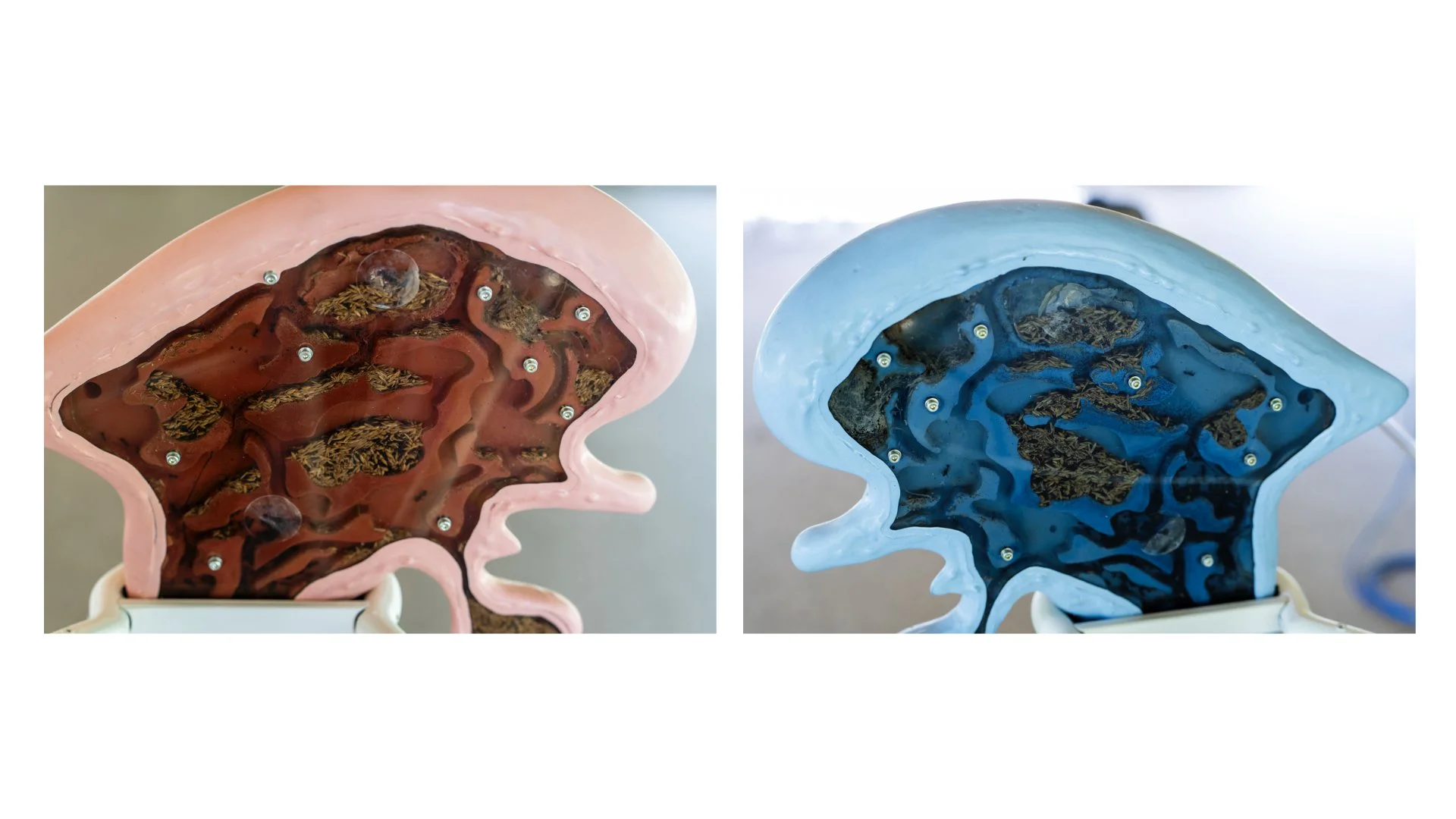
Detail UMWELT Amstel PUK* Processor
Details of PUK* Processor inside exhibition space zone2source showing ants from two different Messor Barbarus colonies. (photo by Roel Backaert)
PUK* Processor (2020) is a specially developed computer server that houses two large ant colonies. The work contains a series of working computational components embedded in plaster modules. Two ant colonies of the species Messor Barbarus live throughout this computational infrastructure. The work brings together two information systems: the binary computational signals of the machines and the pheromone-driven communication of the ant colonies. The work was developed in close collaboration with Matteo Casarin and Ant’s Kingdom.
Within UMWELT Amstel installation PUK* Processor forms a kind of hub into which the sensor data collected outside in the Portal sculptures is funnelled. The two logics of the sensor data and ant colonies collide within the work, creating both the possibility of a malfunction in both systems and, at the same time, a potential symbiosis.

UMWELT Amstel SIM Amstel
Overview of the live-generated video work SIM Amstel on LED screen inside exhibition space zone2source. (photo by Roel Backaert)
The work SIM Amstel is a so-called simulated environment, a digital visualization in which the world beneath the ground of the Amstelpark is made visible. The complexity of this underground world is central to the work, in which various systems – such as tree roots and mycelium, water flows and artificial data networks – are combined in a speculative manner.
The work, developed together with artist and programmer Miša Skalskis, forms the visual endpoint of the installation. It offers a glimpse of an imagined underground world in which mycelia networks can become digital processing units and ants harvest data from cables.
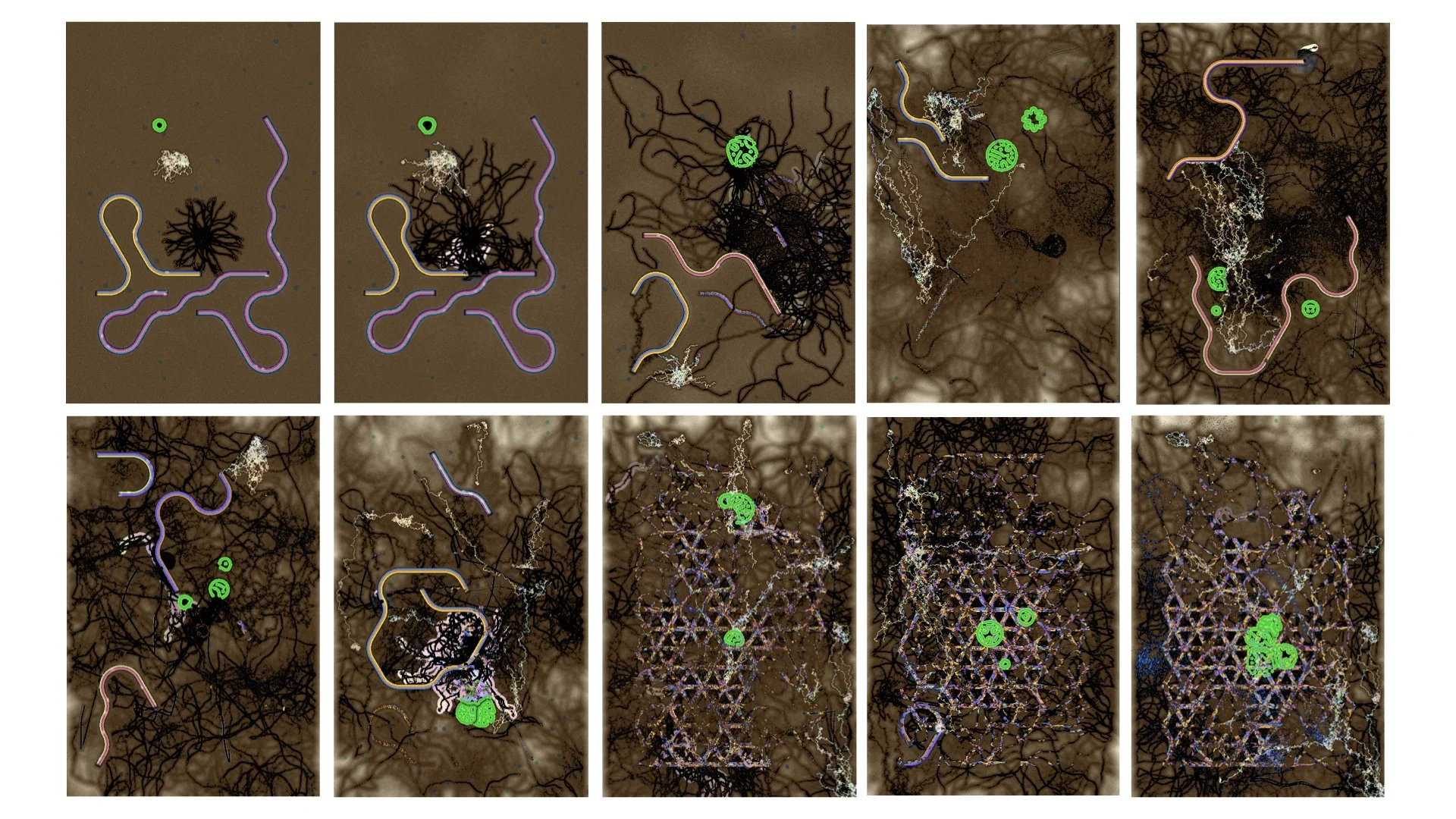
Screenshots SIM Amstel
Screenshots of the development of live-generated video work SIM Amstel within a 24 hour period.
The work SIM Amstel is a so-called simulated environment, a digital visualization in which the world beneath the ground of the Amstelpark is made visible. The complexity of this underground world is central to the work, in which various systems – such as tree roots and mycelium, water flows and artificial data networks – are combined in a speculative manner.
The work, developed together with artist and programmer Miša Skalskis, forms the visual endpoint of the installation. It offers a glimpse of an imagined underground world in which mycelia networks can become digital processing units and ants harvest data from cables.